
Claude Fable 5.1 in Claude Code is built for demanding, long-running work—but the useful skill is not turning every task up to maximum. This guide shows how to match effort to the job, preserve context where it helps, and keep each agent session safe to review.

Claude Fable 5.1 in Claude Code: the quick answer
Claude Fable 5.1 in Claude Code is most useful when a coding task truly needs sustained reasoning: tracing a production failure across services, reviewing a consequential change, mapping an unfamiliar repository, or carrying a carefully scoped refactor through tests. It is not automatically the best choice for a small rename, routine documentation edit, or a question you can answer from one file.
Anthropic’s current documentation says Fable 5.1 defaults to High effort in Claude Code, while the model supports lower and higher effort levels. That default is sensible for a frontier model aimed at ambitious work, but it does not remove the need to choose deliberately. A higher effort can mean more reasoning and tool activity; a broader prompt can make an agent explore more of a repository; and repeated open-ended revisions can turn one task into a long, hard-to-audit session.
Fable 5.1 also changes the economics of cache-heavy API workloads. Anthropic lists cache reads at $0.25 per million tokens and says the lower cache-read price can reduce token-billed costs for workloads that repeatedly reuse processed context. That is important for developers building agents or using API-connected tools. It is not a promise that a personal Claude Code subscription will produce a fixed number of tasks, hours, or files. Subscription capacity, service policy, task shape, and model availability are separate questions.
This article concentrates on the repeatable decisions: how to identify a task that deserves Fable, what effort should mean in practice, how context reuse differs from “paste the whole repo,” when to change models, and how to make an agent run safe enough for a human to approve. For broader plan and rate-limit context, read our existing Claude Code usage limits guide; this is the operational companion for the new model.
What Fable 5.1 adds—and why the details matter
Anthropic introduced Claude Fable 5.1 in early September as its public model for demanding coding, knowledge work, and long-horizon agentic tasks. The official model overview lists a 1-million-token context window, a 128,000-token maximum output, adaptive thinking that is always on, and High as the default effort. Those specifications describe the possible envelope, not a recommendation to fill it on every request.
The launch announcement makes a more nuanced claim about price. Input and output token prices remain separate from the new cache-read line item, while cache reads are substantially cheaper than on the earlier model. Anthropic estimates lower costs for typical token-billed work and larger savings for highly agentic work that repeatedly reads cached context. That explanation is useful because it highlights a real distinction: a long-running workflow can be expensive because it keeps discovering new material, or comparatively efficient because it reuses a stable body of already-processed context. The announcement is the authoritative place to check the current model and pricing claims.
Three implementation details deserve attention before a developer treats the release as a drop-in upgrade. First, the model’s adaptive thinking is always on, so effort and task complexity influence how much reasoning it elects to use. Second, the API documentation identifies migration changes, including restrictions around forced tool use and handling earlier turns with thinking blocks. Third, Fable 5.1 can change effort on a later message without dropping the prompt cache when the required beta behavior is used. That last capability creates a valuable pattern: explore an important problem at a capable setting, then lower intensity for narrowly defined follow-up edits without throwing away useful shared context.
That does not mean every Claude Code session behaves like an API conversation. The interfaces, account settings, and plan controls are not interchangeable. Still, the principle transfers: effort should track uncertainty and consequence, while scope should track the smallest evidence set that can settle the next decision.
Recent community discussion helps explain why this guide is needed. Some users report good results at Medium effort; others report burning through a session after vague, broad requests or a large pile of automatically accumulated project instructions. Those posts are anecdotes, not benchmarks. They do point to a recurring user question: “How do I get a dependable outcome without using the most aggressive model behavior for every stage?” The answer is workflow design, not a universal magic setting.
How to choose an effort level without guessing
Effort is a control for trading off intelligence, latency, and cost. It is not a quality badge. The Anthropic effort documentation recommends High as the Fable 5.1 default, stepping up to xhigh or max for capability-sensitive agentic and coding work, and stepping down to Medium or Low for routine or latency-sensitive work after your own evaluation shows quality holds. The phrase “after your own evaluation” is the part worth keeping.
Teams usually get more value from a small, repeatable calibration exercise than from copying someone else’s setup. Choose three real task classes: a focused bug fix, a review or investigation, and a bounded multi-file change. For each one, define a pass condition before you ask the agent to act. Examples include “the failing regression test passes with no unrelated changes,” “the review names concrete risks with file and line references,” or “the migration touches only these packages and the typecheck is clean.” Run the same class of task at two plausible effort settings, then compare correctness, time, diff size, tool use, and reviewer burden. Record the result in a short project note.
Low effort is not “bad.” It can be ideal when the task is narrow and the evidence is obvious: explain a local function, add an isolated unit test after you have supplied the expected behavior, rename a verified symbol, or draft a concise changelog from a completed diff. A low-effort run still needs constraints. Saying “tidy this module” is broad regardless of the model setting. Saying “replace this deprecated helper in these two files; do not change the public API; run the named test” is a reviewable assignment.
Medium effort is often a productive default for tasks that need judgment but not open-ended exploration. Think of it as the setting for an assistant who should read a small slice of the codebase, propose a plan, make a limited edit, and verify the obvious result. It is a sensible candidate for familiar refactors, test failures with a clear stack trace, documentation that must follow an existing pattern, or a first pass over a pull request. If Medium consistently misses important dependencies, that is an argument to improve the task brief or step up effort for that class—not necessarily for every task.
High effort is appropriate when the real work is deciding what matters. A failing integration test may have a symptom far from its root cause. A cross-service behavior change may require following data across packages and identifying an invariant that a shallow patch would break. A security review may need the agent to connect authorization logic, input paths, deployment configuration, and tests. High effort gives a stronger model more room to reason and verify, but it also makes clear scope and stop conditions more valuable.
xhigh and max should be treated as deliberate escalation modes. Use them when a failed attempt at High has revealed a concrete missing capability, when the impact of an incorrect answer is high, or when a task demands long-horizon coordination and you can still verify the result. Do not use them merely because a prompt is vague. “Understand this repo and make it better” at maximum effort remains a vague request; it simply gives the ambiguity more time to grow.
| Task shape | Reasonable starting point | What to give the agent | Required checkpoint |
|---|---|---|---|
| One known defect in a small area | Low or Medium | Failing test, stack trace, expected behavior, allowed files | Run the targeted test and inspect a small diff |
| Review a pull request or trace a regression | Medium or High | Change summary, risk areas, relevant tests, decision to make | Ask for evidence-linked findings before edits |
| Multi-file refactor with stable acceptance criteria | High | Boundaries, invariants, migration order, test commands | Review after each coherent slice, not only at the end |
| New architecture or complex incident | High, then escalate if justified | System map, constraints, incident evidence, non-goals | Plan and risk register before implementation |
| Open-ended exploration | Do not start with max | A question that narrows the decision first | Turn discovery into a bounded next task |
The model’s effort setting and your prompt have to agree. If you ask for exhaustive research, every alternative considered, full implementation, tests, documentation, and multiple revision passes, you have constructed a high-effort request even if the UI says Low. Conversely, a clearly bounded high-stakes question can benefit from High effort without requiring a sprawling output. Define the job first; tune the setting second.
Prompt cache, context reuse, and the difference between continuity and clutter
Prompt caching is easy to misunderstand because it sounds like a general promise that “long context is cheap now.” It is more specific. When an API workflow repeatedly uses content that has already been processed and stored in the applicable cache, the read of that cached material has a different price from newly processed input. For Fable 5.1, Anthropic documents lower cache-read pricing than the prior model. It does not mean every message is cached, every interface exposes the same controls, or that a long transcript has no downside.
For an API builder, the useful pattern is stable context followed by targeted deltas. A repository map, coding standards, a carefully maintained architecture brief, or a fixed tool contract can be a good shared foundation. The next request adds the ticket, changed files, test failure, or decision at hand. That is fundamentally different from attaching a dump of every document, old chat, terminal output, and generated artifact to each turn.
For an interactive Claude Code user, the equivalent practice is context hygiene. Put durable, project-specific instructions in a clear place. Keep them concise enough that a reviewer can tell whether they are still true. Point the agent to the relevant module rather than asking it to read unrelated directories. When a previous exploration has produced a trustworthy finding, summarize that finding and its evidence instead of making the agent repeat the entire discovery process. If the context is no longer trustworthy, say so explicitly and ask for a fresh inspection.
The new per-message effort behavior has a practical API implication: you can preserve a good shared context while changing how much work the model should devote to the next stage. Imagine a two-part job. First, you use a stronger setting to inspect an unfamiliar repository and propose a migration plan. Then, after a human accepts the plan, later messages each ask for one small migration step, a test update, and a diff explanation at a lower setting. The context remains useful, but the work becomes easier to review. That is a better shape than asking for a complete migration and hoping the final change is correct.
There are four context questions worth asking before an agent begins. Is this information necessary to make the next decision? Is it current enough to trust? Is the agent allowed to see it? Can a human explain why it was included? If any answer is “no,” reduce or replace the context. This simple test helps prevent both wasted tokens and mistaken confidence.
It also helps with portability. A well-structured task brief can move between Claude Code, a code-review tool, a CI job, or another model. A session that works only because it has accumulated an uninspectable transcript is fragile. For more durable project-level instructions, our Claude Code plugin components guide explains how skills, hooks, MCP servers, and related project tooling can shape an agent’s working environment. Use that flexibility to supply useful guardrails, not an ever-growing pile of rules.
Design a Claude Code session that can stop safely
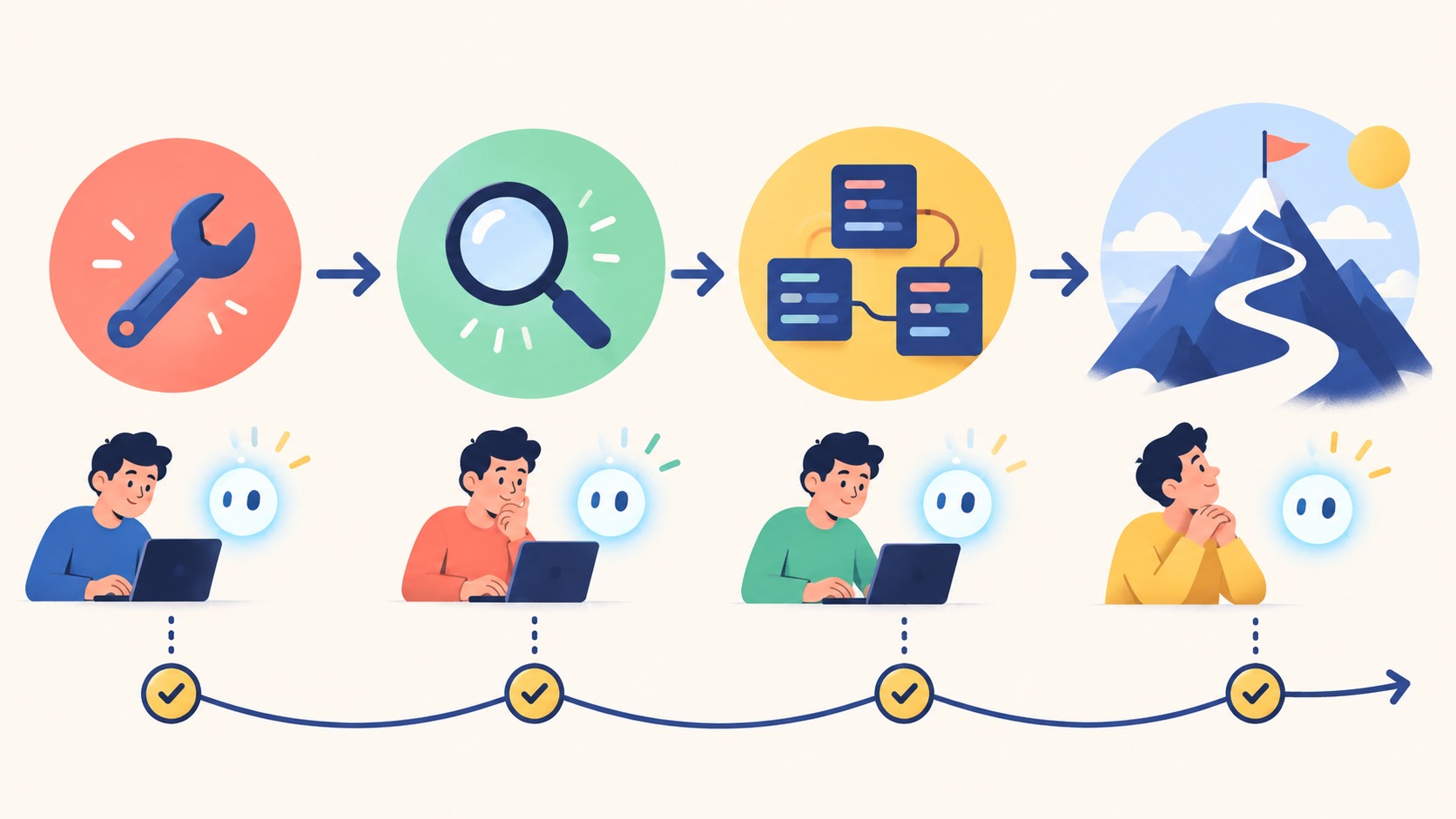
A reliable agent session has an entry condition, a bounded assignment, a proof step, and a stop condition. That sounds formal, but it can fit in a short prompt. The entry condition states what is already known. The assignment names the result. The proof step names the test, diff, or inspection that can check it. The stop condition says when the agent should return control rather than keep exploring.
Here is a safe pattern for a bug fix: “A regression test fails because date-only values shift in the user’s timezone. Inspect the parser and its direct callers. Propose the smallest fix; do not change the public serialization format. Add or update a test that covers the reported offset. Run the targeted test suite. Stop and summarize the files changed, test output, and any ambiguity before touching unrelated code.” This tells the agent what matters and tells the reviewer what to look for.
For a larger task, split planning from implementation. Start with: “Map the call path for this behavior and list the three most likely change points. Identify risks and the tests that prove each risk is controlled. Do not edit files yet.” This is a high-value use of a capable model because it produces a decision artifact. A human can reject a bad plan before it becomes a wide diff. Once the plan is accepted, choose one slice: schema, service, UI, or test migration. Repeat the evidence-and-stop loop for each slice.
Claude Code’s command-line reference documents controls such as non-interactive printing and a maximum-turns limit for programmatic use. The exact command details can change, so consult the current CLI reference before scripting a workflow. The underlying operational lesson is stable: a background or scripted agent should have bounded turns, explicit tools, a controlled environment, and a way to surface a result that a human can inspect.
Permissions belong in session design too. A model does not need write access simply to explain a failing test. It does not need network access to refactor a local module. It does not need a production credential to draft a migration plan. Start with the narrowest permission set that supports the assignment, then expand only when a reviewable reason appears. Our Claude Code Auto Mode guide and permission-rules explainer cover how approval boundaries help teams keep automated work useful without turning every command into a surprise.
Signals a session is healthy
✓ The task names files, behaviors, or decisions rather than a vague ambition.
✓ The agent can explain the evidence for its next action.
✓ A test, lint command, build, or diff review can verify progress.
✓ It has a natural return point for human approval.
Signals to pause or reset
– The same broad instruction leads to repeated revisions.
– The agent keeps opening unrelated areas “just in case.”
– The expected outcome cannot be tested or reviewed.
– More context is being added because the original goal was unclear.
Stopping is not failure. A well-timed stop can preserve the useful discovery an agent has already made while avoiding a cascade of speculative edits. Summarize the current hypothesis, list the evidence, state what would settle the remaining uncertainty, and turn that into the next bounded assignment.
A simple effort and session selector
This helper does not calculate a bill, quota, or guaranteed model outcome. It classifies the operational risk of the task you are about to hand to an agent. The point is to make a conscious choice before a long session begins. Start with the most conservative setting that fits the assignment, then escalate because a defined result demands it—not because the prompt feels important.
Notice that the widget treats unclear acceptance criteria as a reason to plan, not as a reason to select the strongest setting. This is one of the easiest ways to avoid wasted agent work. The agent may be capable of exploring an ambiguous problem, but your team still needs to decide what success means before it writes code.
Switch models by task class, not by habit
Fable 5.1 is positioned for demanding, long-horizon work. The official overview recommends it when a demanding task or evaluation shows that a more economical option at higher effort falls short. That is a useful decision model: choose a model from the requirements of the work, then retain evidence about the result. It is more reliable than treating the newest or most powerful model as a permanent default.
Claude Code offers multiple ways to select a model, including an in-session command, a one-time command-line flag, and an environment-variable default; the model configuration help page is the best place to verify current syntax and availability. For a team, keep a short table in the repository or engineering handbook: which model is preferred for routine assistance, which is allowed for complex reviews or incidents, and when an escalation needs human sign-off.
That table should describe jobs, not identities. “Use the fast model for simple, well-specified changes” is useful. “Always use Model X because it is smarter” is not. The latter loses the opportunity to learn which quality signals really matter in your codebase: test pass rate, review churn, production defects, time to merge, or developer confidence on unfamiliar components.
It is also worth separating API money from subscription limits. The model page documents token prices for API use. A personal or organization Claude plan may have its own capacity, rate windows, feature availability, and policy controls. An efficient cache-aware API agent does not imply an identical result in a subscription session. Conversely, a quota complaint does not prove that a model is intrinsically inefficient; it may reflect task scope, peak capacity, current plan policy, or an accumulated context problem. Keep your language and measurement honest.
For a cross-tool perspective, compare the workflow rather than only the headline price. AI Feature Drop’s OpenAI Codex pricing and usage limits guide and GitHub Copilot app guide make the same underlying point: modern coding assistants vary in their limits, context behavior, model choices, and integration surfaces. The best tool is the one whose operating model your team can understand, review, and use safely for the work it actually does.
Team guardrails for long-running coding agents
As agents become able to work through longer assignments, the main management problem shifts from “can it write code?” to “can we tell what it did, why it did it, and whether it was allowed?” Fable 5.1’s capabilities are a reason to strengthen the work boundary, not to remove it. The larger the assignment, the more you need a clear owner, a test strategy, and an approval point.
Start with a task template. It should include the objective, non-goals, allowed directories, relevant commands, data and secret boundaries, acceptance criteria, and a stop condition. This is not bureaucracy for its own sake. A compact template gives the agent a map and gives the reviewer a rubric. It also exposes gaps in a ticket before the agent spends time trying to infer what the team meant.
Next, make the agent’s output legible. Ask it to report changed files, tests run, assumptions made, commands it could not run, and unresolved risks. For a larger job, ask for that report after every slice. Do not accept “completed” as a sufficient result from a system that made code changes. A reviewer needs a route back to the evidence.
Then, separate research from authority. An agent can inspect logs, search the repository, prepare a migration plan, and draft a patch. That does not automatically authorize it to publish a release, modify production data, rotate secrets, or approve its own pull request. Permission systems, branch protection, CI, and human review are not obstacles to autonomy; they are the structure that lets a team delegate safely. The same principle applies to network and third-party tools. Our Claude Code network allowlist guide has practical advice for keeping external requests explicit rather than letting a prompt quietly broaden the agent’s reach.

Finally, use a feedback loop that measures the things you can act on. Track task class, model and effort choice, whether the first proposed plan was accepted, whether tests caught a problem, and how much reviewer rework was needed. Avoid pretending these figures are universal benchmarks. They are local evidence. After a few weeks, the team can see which assignments deserve Fable 5.1 at High effort, which succeed at a lower setting, and which should remain human-led because the acceptance criteria are not stable enough.
A good operational policy leaves room for experimentation while keeping consequences visible. For example: developers may use a higher-effort agent to investigate an incident in a local or isolated environment; implementation changes require tests and review; production actions require a named approval; and security-sensitive requests follow the organization’s existing process. Anthropic’s enterprise safeguards announcement is relevant context for organizations evaluating advanced models, but each team still needs to define its own access, retention, and audit requirements.
Seven common mistakes—and the safer alternative
1. Treating High effort as the only serious setting
The safer alternative is to classify the task. Use the least intensive option that meets a documented quality bar, and reserve escalation for work where error cost or unresolved complexity justifies it. Lower effort is not a shortcut when the acceptance criteria are clear.
2. Asking for an entire feature in one pass
The safer alternative is to make the agent earn scope. Ask for a repository map and plan, then choose one independently testable slice. This keeps a large project from becoming one opaque diff and reveals wrong assumptions early.
3. Pasting every available document into context
The safer alternative is a curated brief: durable instructions, the relevant files, the immediate evidence, and the allowed tools. Reuse stable context when appropriate, but remove stale or sensitive material instead of treating context size as a feature.
4. Turning an API price into a subscription promise
The safer alternative is to state what the source actually says. Cache-read pricing applies to token-billed API usage. Subscription limits and rate windows are governed separately. If capacity matters to a purchase decision, check the current plan documentation and account interface.
5. Mistaking a long transcript for progress
The safer alternative is evidence. A long agent trace may contain good exploration, but the useful unit of progress is a validated finding, a small reviewable change, or a test result. Ask the agent to summarize those artifacts at a defined checkpoint.
6. Giving production-like authority during discovery
The safer alternative is staged access. Research and planning can usually run with read-only or local access. Move to write, network, or release actions only when a human has approved the next step and the environment is appropriate.
7. Ignoring model migration details
The safer alternative is to read the release and platform notes before updating an automation. Fable 5.1 has documented behavioral and API migration considerations. Put a small compatibility test around the model change, especially if your tool loop assumes a particular reasoning, message-editing, or forced-tool-use behavior.
Final recommendation: let Fable handle the hard thinking, not the undefined thinking
Claude Fable 5.1 gives Claude Code users a stronger option for complicated coding work and a more favorable cache-read rate for token-billed workflows that reuse context intelligently. Those are meaningful improvements. The practical win comes from using them with a sharper operating model.
Start each task by deciding whether the agent needs to explain, inspect, plan, edit, or verify. Give it the evidence required for that stage—not the whole history of the project. Match effort to consequence and uncertainty. Preserve stable context when it is current and permitted. Put tests, diffs, and human approval between major steps. And keep API pricing, subscription limits, and anecdotal user reports in their proper categories.
If you adopt just one habit, make it this: before raising effort or adding more context, rewrite the assignment so a reviewer can tell exactly what would count as a correct answer. That change improves agent results at any setting. It also makes the times when Fable 5.1 truly deserves its extra capability obvious.
Sources and further reading
– Anthropic: Introducing Claude Fable 5.1 and Claude Mythos 5.1
– Anthropic Platform Docs: Claude Fable 5.1 model overview
– Anthropic Platform Docs: effort
– Claude Help Center: Claude Code model configuration
– Anthropic Docs: Claude Code CLI reference
Model availability, plan capacity, pricing, CLI behavior, and safety controls can change. Verify current Anthropic documentation and your organization’s policy before making a purchase, production, or security decision.
Frequently asked questions about Claude Fable 5.1 in Claude Code
What is Claude Fable 5.1 best for in Claude Code?
Anthropic positions it for demanding reasoning and long-horizon agentic work. In practice, it is a strong candidate for unfamiliar repositories, complex incident investigation, consequential code review, and bounded multi-file work with clear tests and human review.
What effort level should I use first?
Anthropic lists High as the default for Fable 5.1. Start there for demanding, clearly scoped coding work; test Medium or Low for routine tasks where your own evaluation shows quality holds. Escalate beyond High only for a concrete capability or consequence reason.
Does a lower cache-read price make every Claude Code session cheaper?
No. The documented cache-read price is for token-billed API use. It applies when eligible processed context is read from cache. It does not promise a fixed subscription quota, and it does not make excessive or irrelevant context free.
Can I change effort without losing useful context?
Anthropic documents per-message effort changes for Fable 5.1 that preserve prompt cache in supported API use. Check current product documentation for the interface you use, and still keep context purposeful and safe.
Should I use Fable 5.1 for every code change?
No. Use task class and evidence to choose a model. Small, well-specified changes often need a lighter workflow. Reserve Fable for work where sustained reasoning, complex context, or high-quality investigation materially improves the outcome.
How can I keep an agent session from getting out of control?
Define allowed scope, acceptance criteria, a proof step, and a stop condition. Split large work into plan and implementation slices, use narrow permissions, inspect diffs, and return to a human after each coherent slice.
Are Reddit reports about Fable 5.1 usage reliable benchmarks?
No. They are useful signals of questions and frustrations, but individual workflows, plans, prompts, service conditions, and repositories differ. Treat them as prompts to test your own task classes, not as universal performance data.
How does this relate to Claude Code permissions and Auto Mode?
Model capability does not replace access control. A good Claude Code workflow still limits tools and permissions to the job, requires review for consequential actions, and keeps network, credential, and production boundaries explicit.
Post a Comment