
Claude Opus 5 gives developers a powerful new coding model, but the feature that quietly changes day-to-day work is the effort ladder. This guide turns effort levels into a practical decision system for Claude Code, API reviews, long-context debugging, and agent workflows.
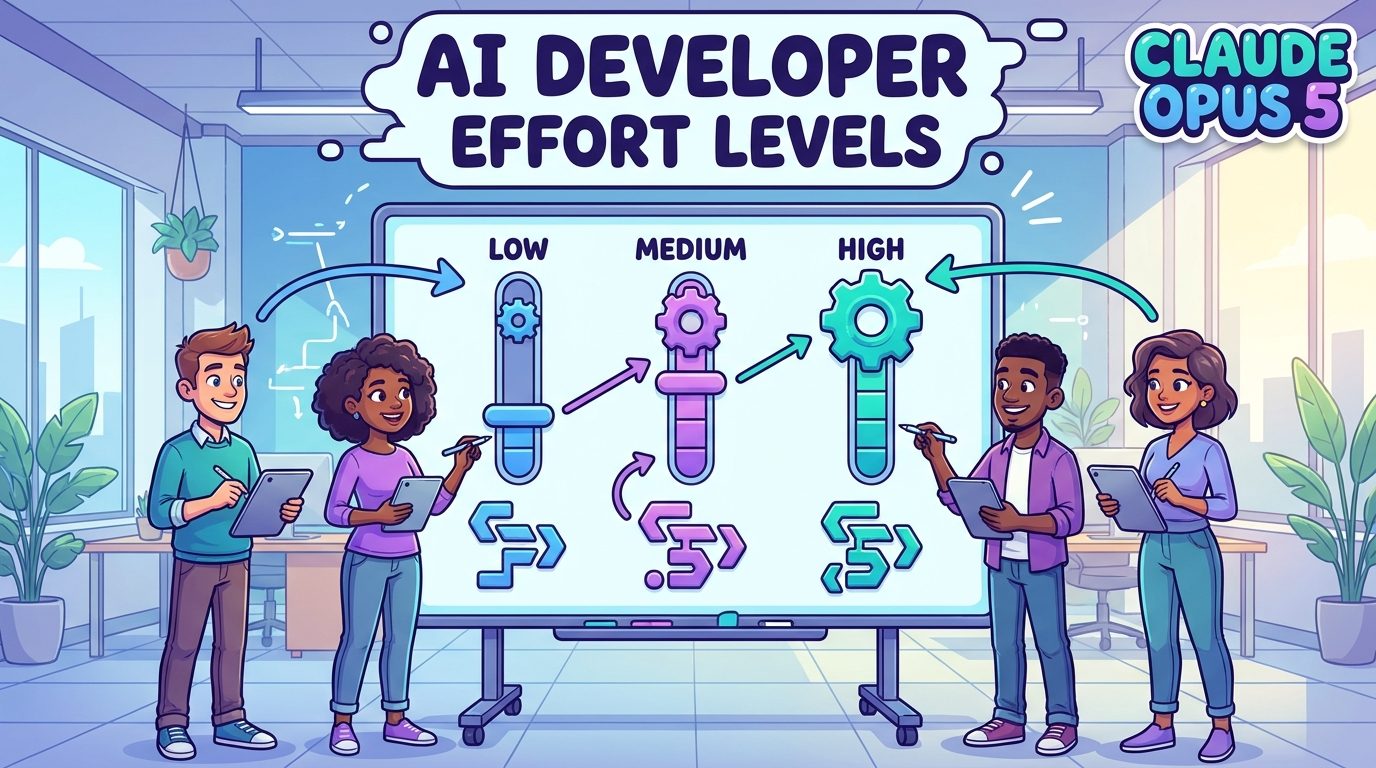
Quick Answer: Which Claude Opus 5 Effort Level Should You Use for Coding?
Use the lowest Claude Opus 5 effort level that can safely complete the decision you are asking the model to make. For simple edits, obvious refactors, test-name cleanup, documentation fixes, and repetitive code transformations, start low. For multi-file debugging, architecture review, migration planning, security-sensitive reasoning, or agent tasks where a wrong plan can waste an hour, move up. For maximum-effort reasoning, reserve it for moments where the model must compare tradeoffs, inspect large context, and produce a plan that humans or agents will execute.
The mistake is thinking effort means “quality setting.” It is better to treat effort as a reasoning budget. Higher effort can improve planning depth, but it can also increase latency, token use, and the temptation to overanalyze tasks that simply need a small patch. Lower effort can be faster and cheaper, but it may miss hidden coupling in a large repository. The practical skill is matching effort to risk, context size, and reversibility.
This cluster article supports our broader pillar, Claude Opus 5 Coding Guide. The pillar explains Opus 5, 1M context, Claude Code, Managed Agents, and safe coding-agent rollout. This guide focuses on one narrow question developers will keep asking: how do you choose effort levels without wasting context, money, or review time?
Why Claude Opus 5 Effort Levels Matter for Coding Agents
Effort controls matter because coding agents are not ordinary chat sessions. A normal assistant answer is usually disposable: if it is wrong, you ask again. A coding-agent action can touch files, run commands, change tests, open pull requests, or produce a plan that a teammate trusts. That raises the cost of shallow reasoning. At the same time, coding work creates enormous opportunities to waste model budget: reading files that do not matter, summarizing context nobody needs, and using high reasoning depth for a one-line fix.
Recent AIFeatureDrop analytics reinforces this pattern. In the current GA4 window, practical coding-agent workflow posts are among the strongest performers, with Codex banked resets, ChatGPT desktop Codex workflows, GitHub Copilot AI credit reduction, and Codex computer-use guides all appearing in top-page data. Organic Search produced 254 sessions in the live analytics pull, while a prior Search Console fallback showed impressions around Claude permissions, Claude Code subagent permissions, and coding-agent setup queries with very low CTR. That combination points to a clear opportunity: readers want operational guides, not broad model hype.
Claude Opus 5 also sits at the intersection of several behaviors developers care about. The latest pillar research summarized Anthropic updates around a larger context window, high output capacity, thinking on by default, an effort ladder, Claude Code default-model changes, and Managed Agents configuration. Those are powerful ingredients, but official documentation is naturally distributed across model pages, release notes, Claude Code material, and agent documentation. Searchers need one practical guide that translates those controls into everyday coding decisions.
Effort selection is especially important when you combine Opus 5 with long context. A 1M-context window sounds like permission to paste everything. In practice, huge context can hide the important signal. If you ask a high-effort model to reason over too much unfiltered context, you may pay for slow thinking about irrelevant files. A good coding workflow narrows the context first, then raises effort only when the model has the right evidence.
The simple mental model
Think of effort as the model’s deliberation depth. The task, not your mood, should choose the setting. Ask three questions before escalating: is the task reversible, is the evidence small enough to inspect confidently, and would a wrong answer create expensive cleanup? If the task is reversible and narrow, use low effort. If it touches several modules or the failure mode is subtle, use medium or high. If the task requires architecture-level tradeoffs, security-sensitive review, or a long agent run that could produce cascading changes, reserve the highest settings for planning and review, not every edit.
Claude Opus 5 Effort Level Matrix for Coding Tasks
The exact labels available in your Claude interface or API configuration may vary, but the practical ladder is stable: lower effort for narrow and reversible work; higher effort for broad, ambiguous, or high-risk work. Use this matrix as a working rulebook rather than a rigid policy.
| Task type | Suggested effort | Why | Guardrail |
|---|---|---|---|
| Rename variables, update docs, fix formatting, write a small helper | Low | The task is narrow, easy to review, and unlikely to require deep architecture reasoning. | Provide exact files and ask for a minimal patch. |
| Add tests for an existing function, refactor a small component, explain a failing unit test | Low to medium | The model needs local reasoning but not a whole-repo plan. | Ask for assumptions and only escalate if the first explanation is uncertain. |
| Debug a bug across two or three files, update an API integration, migrate a small feature | Medium | The task needs causal reasoning across boundaries and may involve hidden dependencies. | Ask for a diagnosis before edits and require a test plan. |
| Review a pull request for regressions, performance risk, or security-sensitive changes | Medium to high | The model must compare intent, diff, context, and failure modes. | Split into passes: correctness first, then security, then maintainability. |
| Plan a multi-step repository migration, agent workflow, or production incident fix | High | The cost of a shallow plan is high, and the model needs to sequence work carefully. | Use planning mode, approve steps manually, and keep edits scoped. |
| Architecture decision, large-context root-cause analysis, or safety-critical agent run | Highest available | Deep tradeoff reasoning is valuable, and mistakes can be expensive. | Use it for planning and review, then execute in smaller low/medium-effort chunks. |
The surprising lesson is that high effort is often best used before editing, not during every edit. Ask Opus 5 to understand the problem, identify the risky files, propose a sequence, and define verification. Once the plan is clear, many implementation steps can move back down to medium or low. That keeps the agent from spending maximum reasoning budget on mechanical changes.
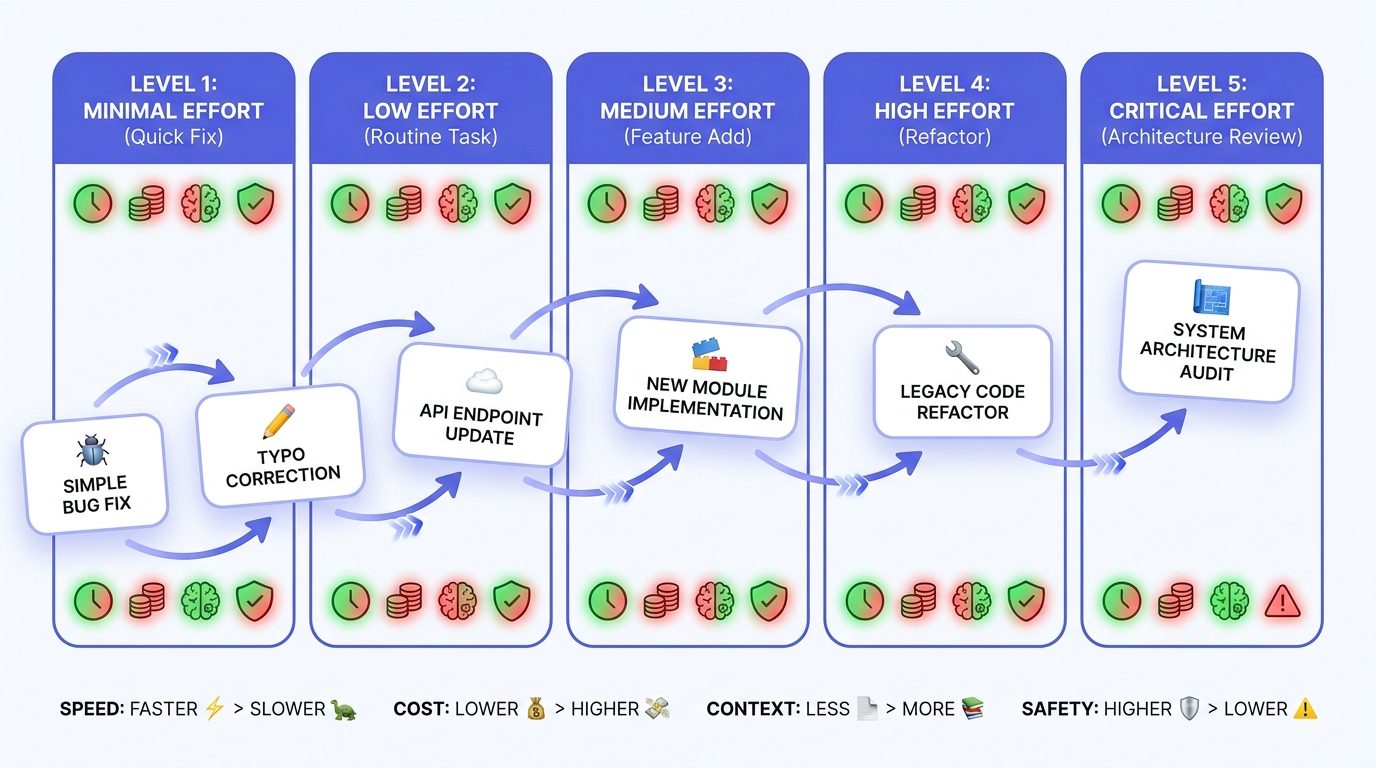
Use effort as a review budget
One effective pattern is to separate generation effort from review effort. For example, ask for a medium-effort patch, then run a high-effort review over the diff and tests. This mirrors human engineering practice: the person who writes the first version does not always provide the final safety review. With Opus 5, you can ask the model to take a second role: “Review the proposed diff as a cautious maintainer. Focus on regressions, hidden assumptions, and missing tests. Do not rewrite unless the problem is concrete.”
A Safer Workflow for Choosing Effort in Claude Code
Claude Code users should be especially careful because effort selection interacts with tool use, repository scope, permissions, hooks, and subagents. A strong workflow is not “turn everything to maximum.” It is a sequence that narrows context, chooses effort, verifies output, and then decides whether escalation is justified.
1. Define the change before choosing effort
Start by writing the smallest honest task description. “Fix auth bug” is too broad. “Find why password reset emails are not sent when the account was created through OAuth, then propose the smallest patch and test” is much better. The clearer the task, the less likely you are to need high effort just to compensate for ambiguity.
2. Ask for a file map first
Before a large edit, ask Claude to identify likely files and explain why each matters. This should be a short discovery step, not a full rewrite. If the model lists twenty files for a narrow bug, that is a sign to tighten the prompt or inspect manually. Good context selection can save more tokens than any effort setting.
3. Pick effort based on risk and uncertainty
Use low effort when the next action is obvious. Use medium effort when the model must connect several facts. Use high effort when the model must reason through competing explanations. If you cannot explain why high effort is needed, you probably do not need it yet.
4. Require a plan before edits for medium and higher effort
For higher-effort tasks, ask for a plan that includes changed files, why each file is included, verification steps, and rollback notes. Do not accept a plan that says “update the codebase” or “improve error handling” without naming specific evidence. A high-effort plan should be more disciplined, not more verbose.
5. Execute in small patches
Even if planning used high effort, patching should stay small. Ask Claude Code to implement one step, run focused tests, then continue. This matters because high-effort agents can become confident enough to make sweeping changes. Small patches preserve human control and make review easier.
6. Use hooks and permissions as external guardrails
Effort is not a safety system. It does not replace permission rules, tool approvals, network allowlists, or statusline visibility. If the agent can run commands, edit files, or access external services, configure those controls separately. Our Claude Code permissions guide, Claude Code hooks guide, and Claude Code statusline guide cover the surrounding guardrails that effort settings cannot provide.
7. Escalate only after observing a failure mode
Escalation should be evidence-based. Move from low to medium when the first attempt misses a dependency or gives an incomplete explanation. Move from medium to high when the task involves conflicting evidence, cross-module behavior, or unclear failure causes. Do not escalate simply because you are impatient; higher effort usually makes the model more deliberate, not magically faster.
Practical Examples: Matching Effort to Real Coding Work
Here are concrete ways to apply the matrix. The examples are intentionally specific because generic “use high effort for hard things” advice is not enough for daily engineering.
Example 1: Small UI bug
Suppose a settings toggle is visually misaligned on mobile. Start low. Give Claude the component file, CSS or layout file, screenshot description, and expected behavior. Ask for the smallest patch. There is no reason to ask Opus 5 to inspect the whole app. The task is local, reversible, and easy to verify with a visual check.
Example 2: Failing integration test
A checkout integration test fails after a dependency upgrade. Start medium. The model needs to inspect the test, dependency change, checkout service, and maybe mock configuration. Ask for a diagnosis first. If the diagnosis points to multiple plausible causes, escalate the review step, not the entire session. A good prompt is: “Compare the old and new behavior, identify the most likely cause, and propose one minimal patch with a test command.”
Example 3: Security-sensitive auth review
For an authentication flow, use medium or high depending on scope. If you are changing password reset, session cookies, OAuth linking, or token refresh logic, the cost of a shallow answer is high. Ask Opus 5 to review threat assumptions, edge cases, and regression tests. Keep the implementation patch narrow, and run the test suite separately. Do not let the agent silently broaden the security model.
Example 4: Large-context migration
A framework migration can tempt you to load the entire repository into a 1M-context session and request a giant update. Resist that. Use high effort for migration planning: inventory modules, categorize risk, choose a sequence, and define checkpoints. Then execute each module in smaller sessions. Long context helps when it contains the right evidence; it hurts when it becomes a junk drawer.
Example 5: Managed Agent background task
If you are configuring a Managed Agent for a background coding workflow, effort becomes part of operational design. Use a higher effort setting for the initial task plan and acceptance criteria, then use lower or medium effort for routine follow-up steps. Stream events, inspect subagent work, and make the agent report assumptions. Background execution should be observable, not just powerful.
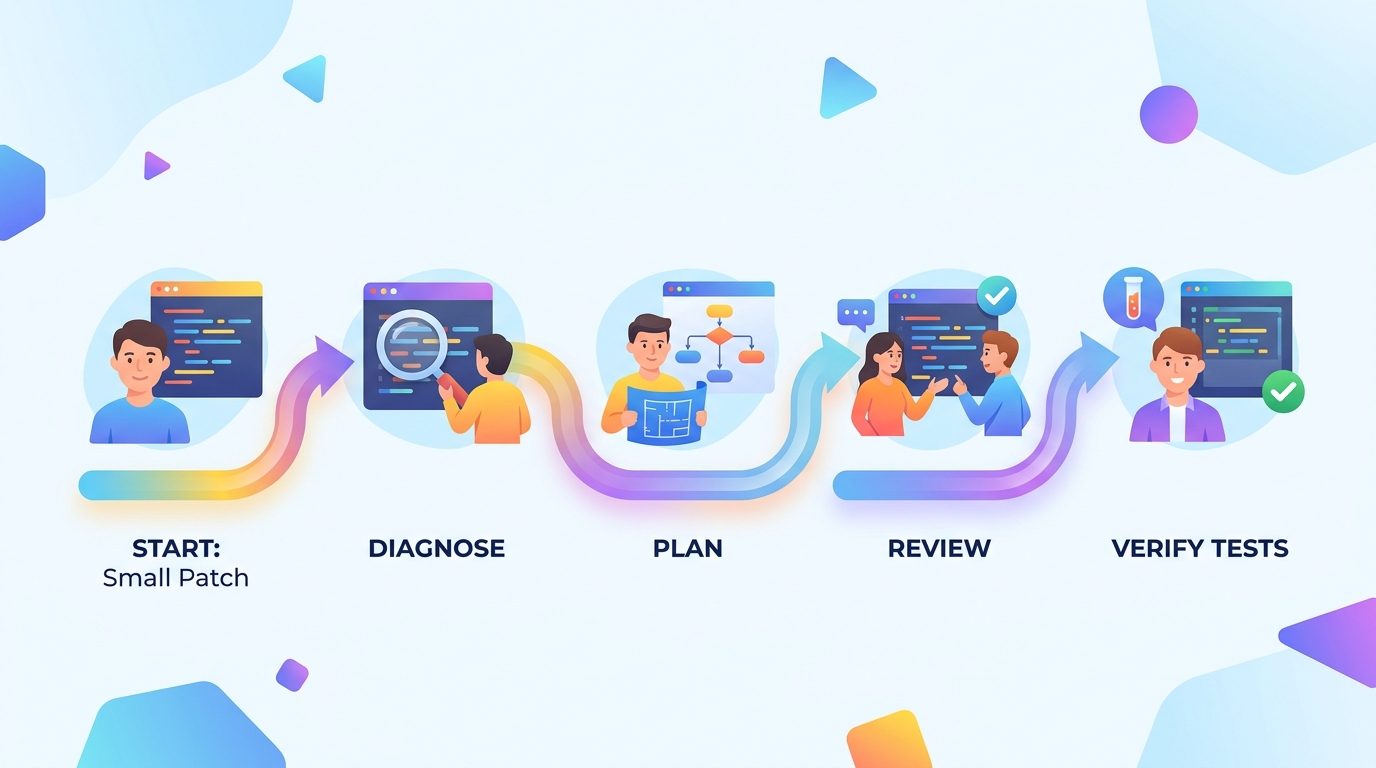
Prompt templates you can reuse
For low effort, try: “Make the smallest safe change in these files only. Do not refactor unrelated code. Explain the diff in three bullets and list one verification step.” For medium effort, try: “Diagnose before editing. Identify likely files, state assumptions, propose a patch plan, then wait for approval.” For high effort, try: “Act as a cautious staff engineer. Compare multiple possible causes, rank risks, define a staged plan, and identify tests that would disprove your recommendation.” These prompts force the model to express reasoning in useful workflow terms without exposing internal chain-of-thought or turning the answer into a rambling essay.
How Effort Interacts With 1M Context and Token Cost
Claude Opus 5’s large context is most useful when you curate it. A huge context window can let the model compare logs, diffs, docs, and files in one session, but it also increases the amount of material the model may need to consider. Higher effort over poorly selected context is the most expensive way to be confused. Before loading a massive repository slice, ask whether the evidence is relevant, fresh, and necessary.
Use a context budget like an engineering budget. Start with the issue, failing test, recent diff, relevant files, and short architecture notes. Add logs only if they answer a question. Add documentation only when the behavior depends on an API contract. Add unrelated directories only after the model explains why they might matter. In many cases, a medium-effort model with a clean 15-file context beats a high-effort model drowning in a 300-file dump.
Also remember output size. Long answers are not automatically better. Ask for concise plans, tables, and patch notes. If you need a deep review, ask the model to separate “must fix,” “should consider,” and “not relevant.” That keeps high effort focused on decisions instead of producing generic commentary.
Opus 5, Sonnet, Claude Code, and Managed Agents: Where Effort Fits
Effort levels do not exist in isolation. You still need to choose the right model surface. Opus 5 is useful for harder reasoning, larger context, and high-stakes coding decisions. A faster or cheaper model may be better for repetitive edits, straightforward tests, or bulk transformations. Claude Code is the interactive local agent surface where permissions, file edits, and terminal verification matter. Managed Agents are better suited to background workflows where configuration, lifecycle events, and observability become part of the product design.
| Surface | Best use | Effort advice |
|---|---|---|
| Claude Opus 5 in chat/API | Deep code reasoning, architecture review, complex debugging, long-context synthesis. | Use medium/high for diagnosis and review; avoid high effort for trivial output. |
| Claude Code | Repository-aware edits, tests, command-driven workflows, local agent loops. | Start low/medium, escalate for planning, protect with permissions and hooks. |
| Managed Agents | Background tasks, repeatable agent workflows, enterprise-style automation. | Set effort per task class and monitor event streams rather than using one global maximum. |
| Alternative coding models | Fast edits, simple test generation, routine transformations. | Use lower-cost models when the task does not need Opus-level reasoning. |
This is similar to the lesson from other coding-agent ecosystems. Our Codex SKILL.md template guide shows how reusable instructions prevent repeated prompting, while the Gemini Managed Agents guide shows how background agents need explicit guardrails. Model effort is only one layer in the broader agent stack.
Common Mistakes With Claude Opus 5 Effort Levels
Mistake 1: Using maximum effort as a default
Maximum effort feels safe, but it can create slower sessions, larger outputs, and overcomplicated patches. Use it when the decision deserves deep reasoning. Do not use it as a replacement for clear prompts, clean context, or tests.
Mistake 2: Loading too much context too early
A large context window is not a mandate to paste the whole repository. Context bloat makes it harder to identify signal. Ask for a file map, then add evidence intentionally.
Mistake 3: Skipping the planning checkpoint
If the task deserves high effort, it probably deserves a plan before edits. A high-effort model that immediately changes files may still miss product intent. Planning creates a reviewable checkpoint.
Mistake 4: Treating effort as permission control
Effort does not stop unsafe commands or data leakage. Use Claude Code permissions, network allowlists, hooks, and human approvals for operational safety.
Mistake 5: Ignoring verification after a strong answer
A polished explanation is not proof. Run tests, inspect diffs, reproduce bugs, and verify the fix. High effort can improve reasoning, but it does not remove the need for engineering discipline.
Good effort habits
- Start with the smallest clear task.
- Use high effort for planning and review when risk is high.
- Keep patches small even after deep reasoning.
- Escalate based on evidence, not anxiety.
- Pair effort with tests, hooks, and permissions.
Bad effort habits
- Maximum effort for every prompt.
- Huge context dumps without file selection.
- Letting agents edit before diagnosis.
- Confusing reasoning depth with safety approval.
- Skipping independent verification.
Quick Effort Picker for Your Next Coding Task
Use this lightweight picker to sanity-check your next Opus 5 coding session. It is not a pricing calculator or official Anthropic tool; it is a practical workflow prompt to help you avoid overusing high effort.
Keep Learning on AI Feature Drop
- Claude Opus 5 Coding Guide — the broader pillar for Opus 5, 1M context, Claude Code, and agent workflows.
- Claude Code Permissions Guide — configure safer tool and file access around agent sessions.
- Claude Code Hooks Team Rollout Guide — automate guardrails and debugging checks without relying on model effort alone.
- Claude Code Statusline Guide — keep agent state, model choice, and session context visible.
- Codex SKILL.md Template — compare reusable agent instructions across coding-agent ecosystems.
- Gemini Managed Agents Guide — another background-agent workflow guide for API builders.
Sources and References
- Anthropic release notes
- Anthropic model overview documentation
- Anthropic extended thinking documentation
- Claude Code overview documentation
- Anthropic agents and tools documentation
Model behavior, effort controls, context limits, and product interfaces can change. Verify the active Anthropic and Claude Code documentation before applying this workflow to production systems.
FAQ: Claude Opus 5 Effort Levels for Coding Agents
What is the best Claude Opus 5 effort level for coding?
The best starting point is the lowest effort level that can safely handle the task. Use low for narrow reversible edits, medium for multi-file diagnosis, and higher effort for architecture, security, incident, migration, or large-context planning.
Should I use maximum effort for every Claude Code session?
No. Maximum effort can be useful for hard planning and review, but it is often unnecessary for simple patches. It can increase latency and produce overcomplicated answers if the task is small.
Does high effort make Claude Code safer?
Not by itself. Effort can improve reasoning depth, but safety also requires permissions, hooks, network controls, scoped prompts, tests, and human review.
How does 1M context change effort selection?
Large context makes careful context selection more important. Use high effort only after you have narrowed the context to relevant files, logs, diffs, and documentation. Otherwise the model may spend more effort on irrelevant information.
When should I escalate from medium to high effort?
Escalate when the first diagnosis misses dependencies, evidence conflicts, the change affects sensitive systems, or the cost of a wrong plan is high. Escalation should be based on observed uncertainty, not habit.
Can I use different effort levels inside one workflow?
Yes. A strong pattern is high effort for planning or review, then lower or medium effort for small implementation steps. This keeps reasoning depth where it matters without making every edit expensive.
Is Opus 5 always better than Sonnet for coding?
Not always. Opus 5 is valuable for harder reasoning and large-context work, while faster or cheaper models may be better for straightforward edits, tests, or repetitive transformations.
What should my first prompt include?
Include the task, relevant files or symptoms, constraints, what not to change, desired verification, and whether you want diagnosis before edits. Clear prompts reduce the need to compensate with higher effort.
Post a Comment