
A practical guide to using Codex banked resets for heavy coding sessions, including prep checklists, prompt templates, reset decision rules, and usage-saving mistakes to avoid.
Quick Answer: Use a Codex Banked Reset Only When the Task Is Big Enough
Codex banked resets are best treated like a saved high-focus coding block, not like a casual chat refill. Use one when you have a bounded but substantial software task: a multi-file bug fix, a refactor with tests, a feature branch that needs careful review, a dependency migration, or a debugging session where Codex needs enough context to reason across files. Do not spend one on scattered questions, vague repository cleanup, or prompts that could be answered by a small local edit.
This article is the focused workflow companion to our broader pillar, Codex Banked Resets Explained. The pillar explains what banked resets are and how they fit into OpenAI Codex usage limits. This cluster article answers the next practical question: when should you actually use one, and how do you avoid wasting it?
OpenAI’s current Codex help material says usage depends on plan, task complexity, where tasks run, context size, and session length. Small scripts may consume only a fraction of an allowance, while large codebases and extended sessions can use much more. That means the winning habit is not “use Codex less.” It is “use Codex with a tighter task shape.”
What a Codex Banked Reset Is Actually For
A banked reset is useful because AI coding work is bursty. Developers do not need the same amount of agentic usage every hour. Some days are light: autocomplete, a few explanations, a small script. Other days involve a messy production bug, a framework migration, a test-suite repair, or a feature that touches several files. A banked reset makes the heavy day easier to plan.
Think of it as a way to protect a meaningful engineering session. You are not buying magic. You are creating room for Codex to inspect context, make a plan, propose changes, run commands where available, and iterate with you. The more complex the task, the more important it becomes to define the boundaries before the agent starts.
| Task type | Good reset candidate? | Why |
|---|---|---|
| Explain one function | No | Usually too small. Use normal chat or a lightweight model. |
| Fix a failing test with stack trace | Maybe | Worth it if the failure spans several files or needs investigation. |
| Refactor a module with tests | Yes | Bounded, verifiable, and likely to benefit from iteration. |
| Explore an unfamiliar monorepo | Maybe | Useful if you define the subsystem and questions first. |
| Clean up the whole repository | No | Too vague; split into smaller tasks first. |
| Dependency migration | Yes | High-value if docs, impacted files, tests, and rollback path are clear. |
The key is verifiability. A good Codex session ends with a diff, a passing test, a clear explanation, or a decision you can act on. A weak session ends with a long conversation and no reliable next step.
Before You Spend a Banked Reset: The Five-Minute Prep
The fastest way to waste Codex usage is to start with a vague prompt and let the agent discover the task from scratch. Discovery is sometimes useful, but it is expensive when you already know the bug, files, or target behavior. Spend five minutes preparing the session, and you usually save many minutes of agent wandering.
A strong starting prompt says: “In this repository, fix the failing payment webhook retry test. Focus on webhook_handler, retry_policy, and the failing log below. Do not change public API behavior. First explain your plan, then patch the smallest set of files, then run the targeted test command.” That prompt gives Codex a target, scope, constraint, and verification step.
A weak starting prompt says: “Look through this repo and fix anything wrong.” It sounds efficient, but it invites broad context, unnecessary exploration, and repeated iterations. If you are spending a saved reset, broad exploration should be intentional, not accidental.
A Practical Heavy Codex Session Workflow
Use this sequence when the task is important enough to deserve a banked reset. It works for Codex web, the Codex app, the IDE extension, and CLI-style workflows, though the exact buttons and environment controls vary by surface.
Step 1: Ask for a plan before edits
Start with planning mode. Ask Codex to identify likely files, risks, tests, and unknowns. Do not accept code immediately. Planning first makes the session cheaper and safer because you can correct assumptions before the agent edits.
Step 2: Approve a narrow first patch
The first patch should be boring. It should touch the smallest useful set of files. If Codex proposes a broad redesign, ask it to reduce the scope. If the task really requires a redesign, split the session into phases.
Step 3: Run one targeted verification
Use a targeted test, typecheck, lint command, or build step. Avoid running the full test suite at every tiny iteration unless the repository is small. Codex works better when feedback is specific.
Step 4: Review the diff like a maintainer
Do not treat agent output as finished just because it compiles. Check behavior, edge cases, naming, tests, security, and whether the code fits project conventions. OpenAI positions Codex as a coding agent that can write, review, debug, and automate tasks, but you remain responsible for the shipped change.
Step 5: Decide whether the next iteration is worth it
After each iteration, pause. Is Codex getting closer? Are tests improving? Is the diff getting smaller and clearer? If the agent is circling, stop the reset session and rewrite the problem. Repeated “try again” prompts are one of the easiest ways to drain usage without improving the result.
Prompt Templates That Save Codex Usage
The best prompts for banked reset sessions are not fancy. They are specific, bounded, and test-aware. Copy these patterns and adapt them to your repository.
Bug fix prompt
Goal: Fix the failing [test name] without changing public behavior.
Context: The failure appears in [file/log]. Relevant files are [files].
Constraints: Keep the patch minimal. Do not refactor unrelated code.
Process: First explain likely cause, then propose a patch, then run [test command].
Stop when: The targeted test passes or you can explain the blocker.
Refactor prompt
Goal: Refactor [module] to improve [specific outcome].
Scope: Only edit [directory/files].
Do not change: Public API, database schema, auth behavior, or tests outside scope.
Verification: Run [test/typecheck/lint].
Deliverable: Small diff, migration notes, and any follow-up risks.
Code review prompt
Review this diff as a maintainer.
Focus on: correctness, edge cases, security, performance, and test gaps.
Ignore: style nits unless they affect readability or conventions.
Output: prioritized issues with file references and suggested fixes.
These templates reduce ambiguity. They also make it easier to stop the session, because success is defined before the agent starts. That matters when a reset or credit purchase gives you extra room but not infinite room.
Best Use Cases for Spending a Codex Banked Reset
The strongest use cases share three traits: the work is valuable, the scope is bounded, and the result can be verified. Here are the sessions most likely to justify spending a reset.
For a solo developer, the reset is usually worth it when Codex can save an uninterrupted block of deep work. For a team, it is worth it when the session produces a patch, review, or explanation that other engineers can trust and reuse.
Mistakes That Waste Codex Banked Resets
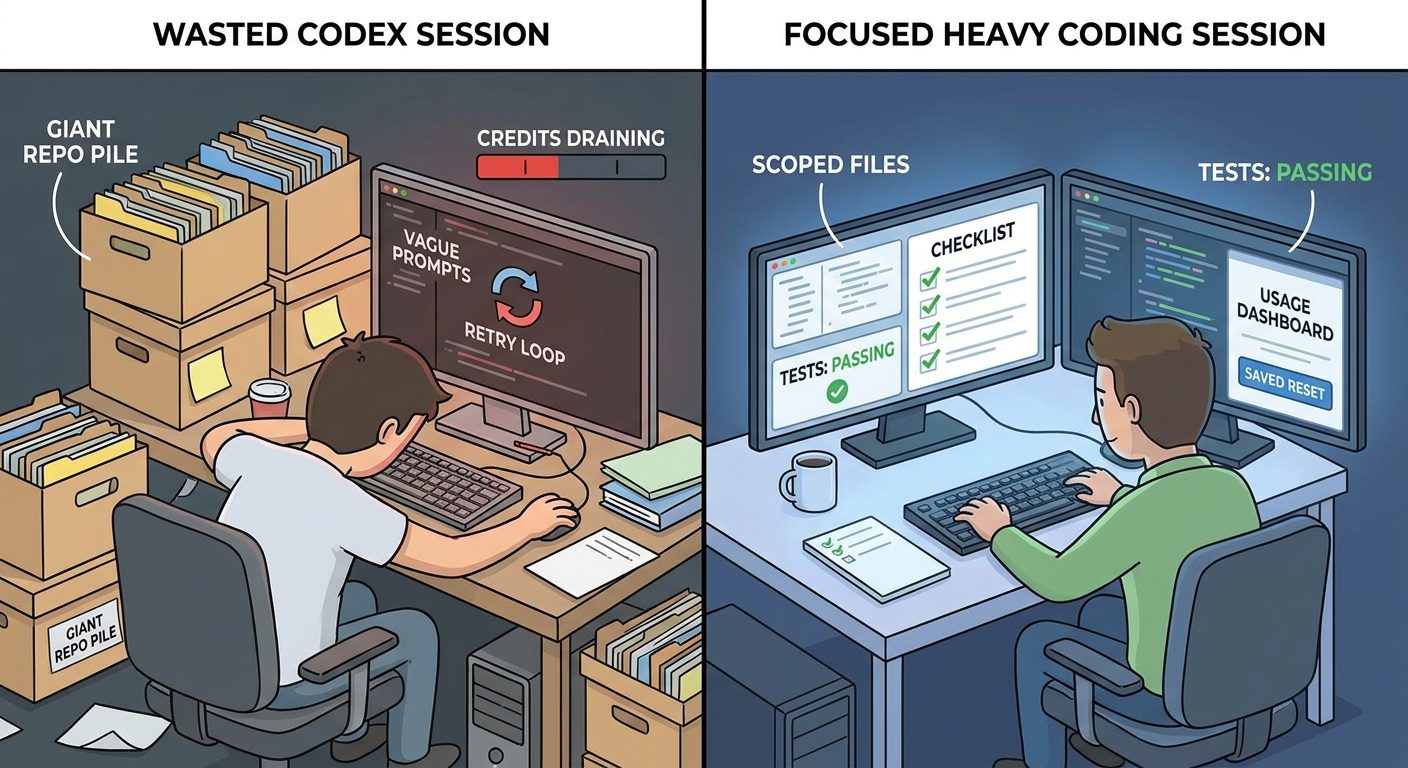
Good reset habits
- Start with a one-sentence outcome.
- Attach only relevant files and logs.
- Ask for a plan before edits.
- Use targeted tests after each patch.
- Stop when the agent starts looping.
- Save a summary for future sessions.
Usage-draining habits
- “Clean up this repo” prompts.
- Attaching the entire codebase by default.
- Changing goals mid-session.
- Repeated “try again” without new evidence.
- Using premium models for tiny edits.
- Skipping tests until the end.
The most subtle mistake is mixing exploration and execution. Exploration asks, “What is going on?” Execution asks, “Make this change.” Both are valid, but combining them in one giant prompt can create long, messy sessions. If you are unsure, use a small non-reset interaction first to map the problem, then spend the banked reset on the actual implementation.
Team Policy: How Engineering Leads Should Handle Banked Resets and Credits
For teams, Codex usage planning should be part of engineering operations, not an individual mystery. OpenAI’s help material notes that Codex usage from Codex, ChatGPT for Excel, and Workspace Agents counts toward agentic usage, and that Business and Enterprise workspaces have additional controls such as RBAC, app controls, Compliance API logging, Sites controls, and developer-mode policies. Those controls are useful only if teams define when heavier usage is appropriate.
| Policy question | Recommended answer |
|---|---|
| Who can spend heavy usage? | Engineers working on defined tasks, not open-ended exploration. |
| What must be prepared? | Issue link, files, logs, test command, acceptance criteria. |
| What must be reviewed? | Diff, tests, security-sensitive changes, generated docs, and assumptions. |
| What gets logged? | Task, outcome, time saved, failures, and follow-up work. |
| What gets escalated? | Repeated failures, large architectural changes, security-sensitive edits, or unexpected cost spikes. |
A good policy does not shame developers for using AI. It helps them spend agentic usage where it has the highest return. If a reset helps fix a painful bug faster, that is a win. If it produces a large unreviewable diff, that is a workflow smell.
Decision Tree: Should You Use a Banked Reset Now?
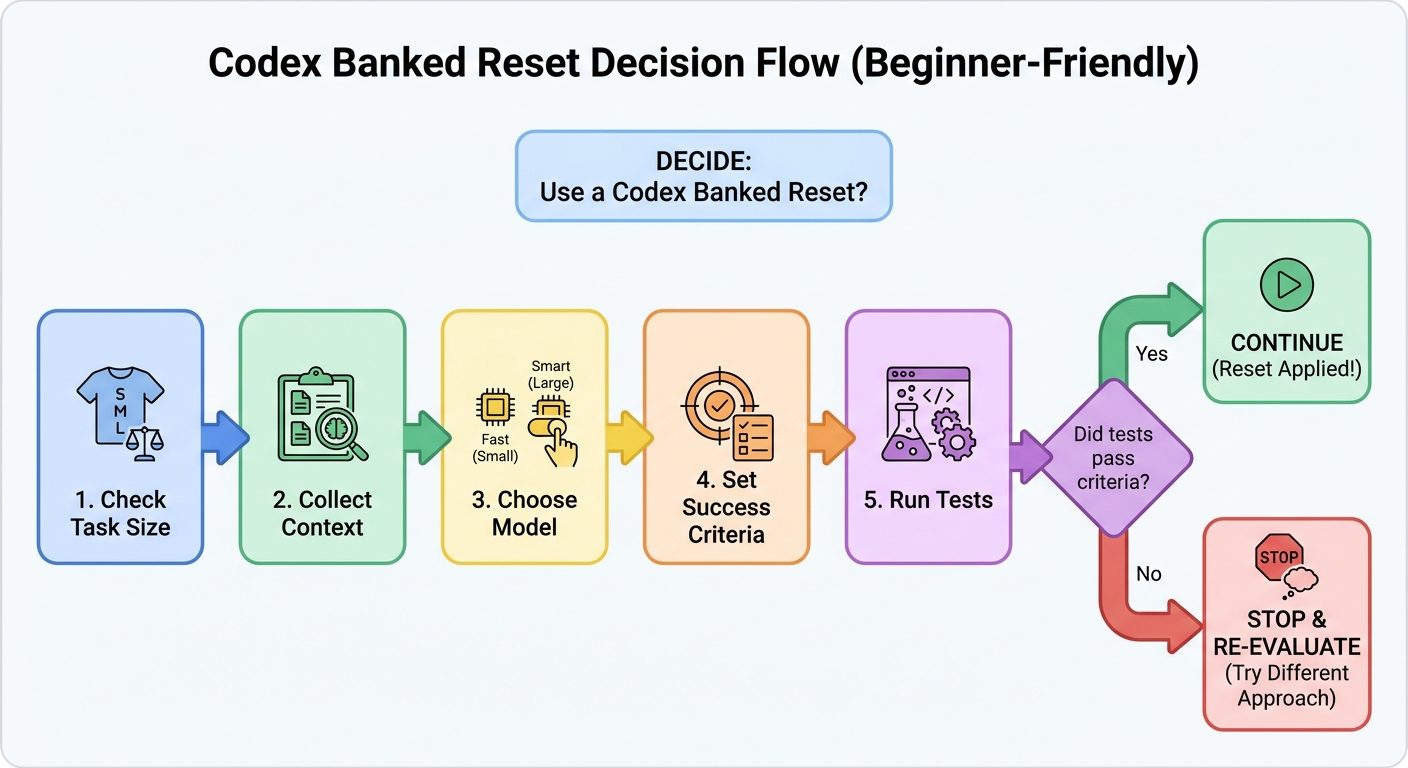
Ask these questions in order. If the answer is “no” before step four, wait.
- Is the task worth a focused coding block? If not, use normal Codex usage or a lighter assistant interaction.
- Can you define the result? If the goal is vague, spend time scoping first.
- Do you know the relevant context? If not, run a short discovery prompt before spending the reset.
- Can you verify the output? If there is no test, build, typecheck, review checklist, or acceptance criterion, create one.
- Will the session stop at a clear point? If not, set a stop rule: one plan, one patch, one test cycle, then review.
If all five answers are yes, the reset is probably well spent. If several answers are no, the reset will likely become an expensive brainstorming session.
Advanced Planning: Turn One Reset Into Three Smaller Wins
A banked reset feels most valuable when it produces a complete fix, but the safer pattern is often to divide the session into three smaller wins: diagnosis, patch, and review. In the diagnosis phase, ask Codex to map the failure, identify the smallest relevant files, and list unknowns. In the patch phase, ask for one implementation path and one targeted verification command. In the review phase, ask Codex to inspect its own diff as if it were a maintainer who did not write the code.
This structure is useful because heavy coding sessions usually fail for one of two reasons. Either the agent starts editing before it understands the codebase, or the developer keeps asking for revisions after the task has become ambiguous. A phase boundary gives you a natural pause. If the diagnosis is wrong, do not continue to patching. If the patch is too large, do not continue to review. If the review finds unresolved risk, stop and split the task.
For example, a framework migration can become three separate Codex tasks. First, ask Codex to inspect imports and produce a migration inventory. Second, ask it to update one representative module and tests. Third, ask it to create a repeatable checklist for the remaining modules. That is usually better than asking Codex to migrate everything at once, especially when the repository has custom abstractions or historical edge cases.
The same pattern works for debugging. The diagnosis phase should produce a hypothesis and evidence. The patch phase should change the smallest code path that tests the hypothesis. The review phase should ask whether the fix handles edge cases and whether the test actually proves the behavior. This turns a reset from a long conversation into a controlled engineering loop.
After the Session: Capture What Codex Learned
A banked reset should leave behind more than a patch. It should leave behind reusable knowledge. Ask Codex for a short handoff note before you end the session: what changed, which files mattered, which tests were run, what risks remain, and what a future developer should know before touching the same area again. This note can go into the pull request body, an issue comment, or a project notebook.
The handoff note is especially valuable when Codex investigated a confusing bug. Even if the final code change is small, the investigation may reveal hidden assumptions, flaky tests, outdated documentation, or a dependency behavior that will matter again. Saving that context prevents the next heavy session from starting from zero.
For teams, this also creates a lightweight audit trail. You can compare the cost of the reset with the usefulness of the output. Did the session produce a merged pull request, a reliable diagnosis, a rollback plan, or a reusable checklist? If yes, the reset probably paid for itself. If the session ended with uncertainty and no artifact, improve the prompt template before spending another one.
Over time, these notes become your local Codex playbook. They show which prompts work in your codebase, which test commands give useful feedback, which directories need clearer docs, and which tasks should remain human-led. That learning loop matters more than any single saved reset.
Keep Learning on AI Feature Drop
Sources and References
- OpenAI Help Center: Using Codex with your ChatGPT plan
- OpenAI Developers: Codex overview
- OpenAI Developers: Codex web and cloud delegation
- OpenAI Developers: Codex pricing and credit options
Codex plans, limits, pricing, and credit options can change. Always verify your current ChatGPT or workspace plan before making purchase or budget decisions.
FAQ: How to Use Codex Banked Resets
When should I use a Codex banked reset?
Use one for a substantial, bounded, verifiable coding task such as a multi-file bug fix, dependency migration, refactor with tests, or long debugging session. Avoid spending one on vague exploration.
Can a small task waste a banked reset?
Yes. If the task is a one-function explanation, small script, or quick edit, normal usage is usually enough. Save banked resets for work that needs sustained agentic reasoning.
How do I make a heavy Codex session cheaper?
Start with a plan, attach only relevant context, use targeted tests, avoid repeated vague retries, and stop when the agent begins looping.
Do Codex messages consume the same amount of usage every time?
No. OpenAI says usage varies based on task size, complexity, where the task runs, context size, and session length. Larger codebases and longer sessions can consume more.
Should teams create a Codex reset policy?
Yes. Teams should define what tasks justify heavy usage, what evidence is required, how generated diffs are reviewed, and how usage or credits are monitored.
Post a Comment