
MAI-Code-1-Flash Explained: Fast GitHub Copilot Model for Agentic Coding Workflows
MAI-Code-1-Flash is Microsoft AI’s fast coding model for GitHub Copilot Business and Enterprise. This guide explains what it is, when it fits, how usage-based billing changes the decision, and how teams should roll it out without turning model choice into guesswork.

MAI-Code-1-Flash: Quick Answer
MAI-Code-1-Flash is Microsoft AI’s in-house coding model, made available for GitHub Copilot Business and GitHub Copilot Enterprise. GitHub describes it as purpose-built for coding and optimized for Copilot, with fast, low-latency responses suited to high-volume, iterative agentic coding workflows where speed and efficiency matter.
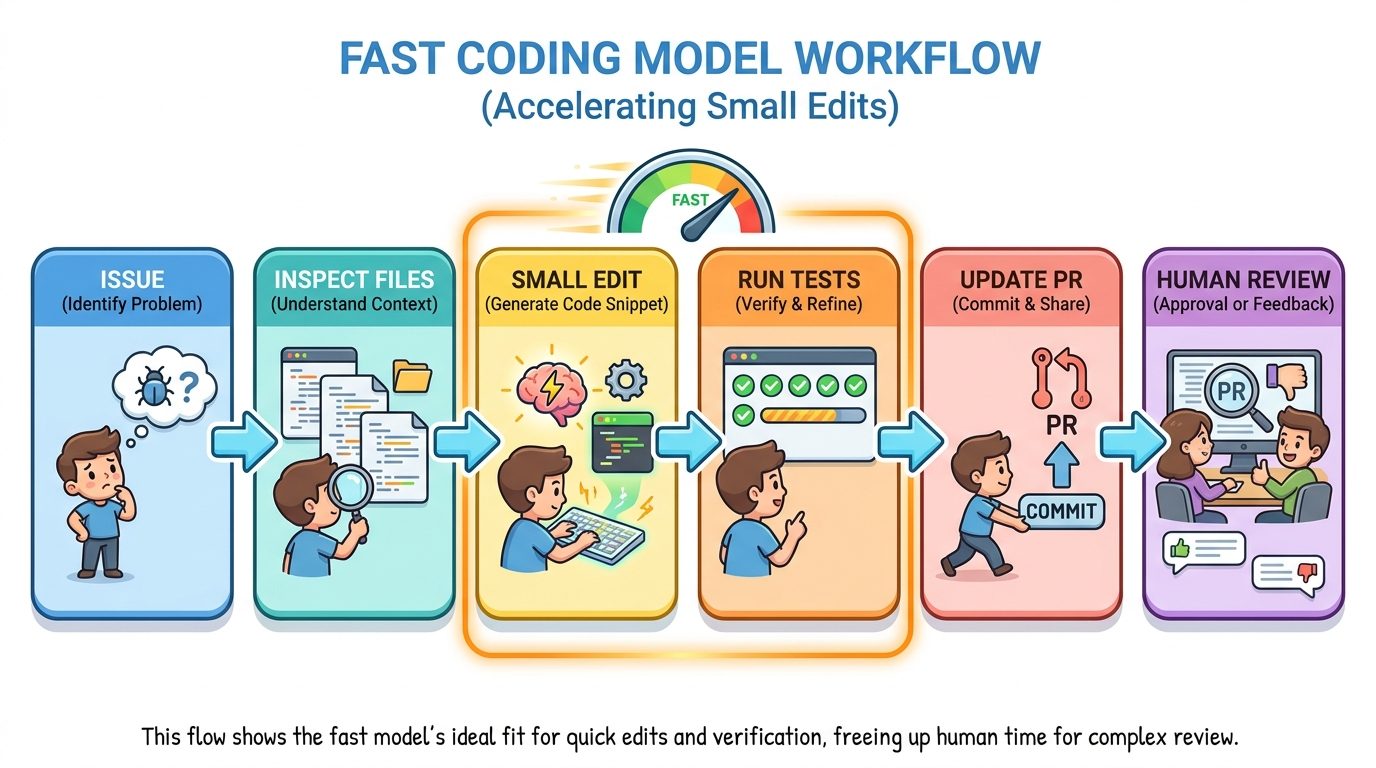
The important phrase is not only “fast model.” The real product shift is that Copilot is becoming a model marketplace and agent platform at the same time. Developers now use Copilot in chat, IDE agent mode, code review, CLI, pull-request workflows, Jira, and background coding-agent tasks. A fast coding model can be extremely useful in that world because many agent sessions are not one giant reasoning leap. They are dozens of smaller loops: inspect a file, draft an edit, run a check, summarize a diff, respond to review feedback, or search for the right context.
This article focuses on practical search intent: what MAI-Code-1-Flash means, who gets access, how it connects to GitHub AI Credits, how it compares with auto model selection, what Business and Enterprise admins should configure, and which workflows are likely to benefit most.
What Is MAI-Code-1-Flash?
MAI-Code-1-Flash is a Microsoft AI coding model available inside GitHub Copilot for eligible Business and Enterprise customers. According to GitHub’s changelog, administrators must enable the MAI-Code-1-Flash policy in Copilot settings before users can access it. That makes the feature both a developer tool and an organization-governance decision.
In plain English, a coding model is the brain Copilot uses for a specific interaction. Copilot can route requests to different models depending on plan, surface, policy, feature, and user choice. Some models prioritize deep reasoning and broad context. Some prioritize lower latency and efficient iteration. MAI-Code-1-Flash belongs in the second bucket: a coding-specialized model intended to feel quick when developers are asking Copilot to do repeated coding work.
That does not mean it should be treated as weaker by default. Speed matters in software work. If a model is fast enough to stay in a developer’s flow, it can be more useful than a slower model that feels impressive but interrupts the rhythm of editing, testing, and reviewing. The trick is matching the model to the task. The wrong expectation creates disappointment: a fast coding model is not a guarantee that every architectural decision, migration, security review, or large pull request will be handled perfectly.
AIFeatureDrop’s analytics also make this topic timely. Over the last 28 complete days, Microsoft and GitHub Copilot content has been one of the strongest clusters on the site. The Copilot Cowork Skills and Plugins guide, the GitHub Copilot AI Credits Calculator, and the Copilot AI Credits reduction checklist all show that readers care about the same underlying problem: how to use Copilot productively without losing control over cost, context, and quality.
Why MAI-Code-1-Flash Matters for Copilot Users
Copilot used to be easier to explain. It completed code, answered questions, and helped with small edits. Now Copilot is a stack of related workflows: inline completion, chat, agent mode, CLI, code review, Jira integration, pull-request assistance, MCP-connected agents, and background coding tasks. As Copilot gets more capable, model choice becomes a product feature rather than a hidden implementation detail.
GitHub’s recent updates make that visible. Copilot code review now has analysis-depth controls and uses CLI-style file exploration tools such as grep, rg, glob, and view to focus reviews. Copilot CLI has a redesigned terminal interface with tabs for issues, pull requests, and gists, plus in-session configuration for MCP servers, skills, and plugins. Copilot for Jira reached general availability with streaming agent progress and post-session steering. These are not isolated releases. They are signs that Copilot is becoming an operating layer for software work.
In that operating layer, a fast model can be a force multiplier. Agentic workflows often involve repeated small decisions: identify the relevant file, make a narrow change, inspect the result, follow repository instructions, update a PR description, or respond to a comment. If every step waits on a heavyweight model, the workflow can feel expensive and slow. A fast coding model gives Copilot another gear.
The search gap is that most official documentation explains model availability, policy, and pricing in product terms. Developers need a different explanation: “Should I actually use this model? For what? What should I avoid? How does it affect credits? When should my team enable it?” That is the gap this guide fills.
MAI-Code-1-Flash vs Auto Model Selection vs Powerful Models
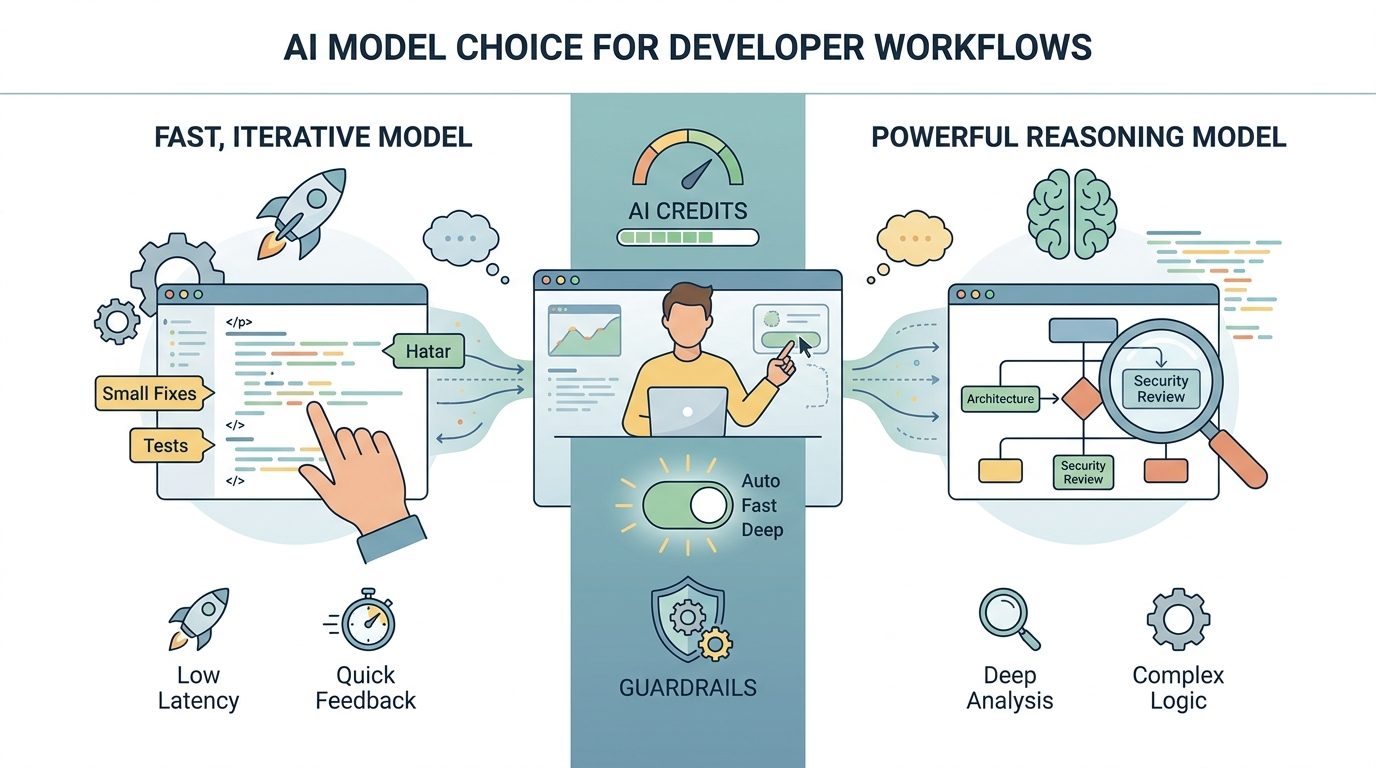
The safest way to think about model choice is to separate three modes: automatic routing, fast coding models, and powerful reasoning models. Auto model selection is useful when a developer does not want to think about the model at all. GitHub says auto model selection dynamically chooses a model for the task, subject to plan restrictions. That is a good default for casual use and for Free or Student plan experiences where manual selection is simplified.
Manual model choice becomes more valuable in teams with repeatable work patterns. If a team knows that a large share of Copilot usage is routine edits, test generation, documentation, code review iteration, or issue triage, a fast model can reduce friction. If a team regularly asks Copilot for architectural analysis, threat modeling, unfamiliar domain work, or large migrations, a more powerful model may be worth the additional wait and cost.
| Task type | Good fit for MAI-Code-1-Flash? | Why |
|---|---|---|
| Small bug fixes | Often yes | Fast inspection and edit loops are useful when scope is narrow and tests are available. |
| Unit tests and fixtures | Often yes | Test scaffolding benefits from speed, repetition, and repository conventions. |
| Documentation updates | Often yes | Low-latency drafting and cleanup can save time without needing deep reasoning. |
| Code review triage | Sometimes | Efficient review is valuable, but security-sensitive or architecture-heavy changes need deeper scrutiny. |
| Large migration plans | Use carefully | A fast model can help break down work, but final planning may require a stronger model and human review. |
| Security design decisions | Usually not as the only model | Latency is less important than careful reasoning, context, and human approval. |
The mistake is treating model choice like a leaderboard. The better model is the one that fits the work. A lightweight or fast model can be excellent for frequent interactions. A powerful model can be excellent for fewer, higher-stakes decisions. A healthy Copilot setup gives developers both options and teaches when to switch.
Where MAI-Code-1-Flash Fits in Agentic Coding Workflows
Agentic coding sounds dramatic, but most useful agent workflows are boring in the best way. They take repetitive engineering chores and move them through a controlled loop. A developer describes a task, Copilot inspects the repository, proposes or makes changes, runs checks where available, opens or updates a pull request, and responds to feedback. Speed helps because the developer is not waiting for a single answer; they are supervising a sequence.
For a practical example, imagine a Jira ticket that says a settings page needs clearer validation messages. A team member can assign the issue to Copilot, watch progress from Jira, and steer follow-up instructions after a draft pull request is opened. MAI-Code-1-Flash may be a good model for the iterative parts: finding the relevant UI component, editing copy, adding tests, and updating the PR. If the ticket reveals a deeper validation architecture problem, that is the point to slow down and switch to a stronger model or human design review.
Another example is code review. GitHub’s recent Copilot code review updates point toward more efficient file exploration and configurable analysis depth. A fast coding model can help with the first pass: locate relevant code, summarize likely issues, and suggest mechanical changes. But if the change touches authentication, billing, permissions, or data loss risk, teams should not confuse “fast review” with “complete assurance.” Copilot can assist, but final accountability stays with people.
How GitHub AI Credits Change the MAI-Code-1-Flash Decision
Model choice now has a billing dimension. GitHub’s pricing documentation explains that Copilot interactions consume input tokens, output tokens, and cached tokens; the model and number of tokens determine cost; and usage converts into GitHub AI Credits, where one AI credit equals one cent. Individual plans include allowances, while Business and Enterprise plans include per-user allowances pooled at the billing entity level. Additional usage is billed according to the model pricing tables.
That means MAI-Code-1-Flash is not only about developer experience. It is also about cost visibility. GitHub’s changelog notes that MAI-Code-1-Flash is billed at provider list pricing under usage-based billing. Teams should read the live pricing table before making budget decisions, because model rates and availability can change. The practical principle is stable, though: a model optimized for fast, high-volume workflows should be evaluated by both productivity and credit efficiency.
Developers can reduce waste by tightening context. Do not drag an entire repository into a prompt when a file, diff, or issue reference is enough. Do not run repeated vague prompts like “fix this better” when a precise instruction would do. Do not use agent mode for tasks that are faster as one manual edit. And do not choose the most powerful model for every small loop just because it sounds safer. Safety comes from scope, tests, review, and permissions, not only from model size.
This is why MAI-Code-1-Flash pairs well with existing AIFeatureDrop guidance on GitHub Copilot credits. If your team already tracks where credits go, this model gives you another lever: reserve powerful models for complex reasoning and use fast coding models for high-frequency implementation loops.
Business and Enterprise Rollout Checklist
Because MAI-Code-1-Flash access is controlled by administrators for Copilot Business and Enterprise, rollout should be deliberate. A fast model can improve developer flow, but unmanaged model access can create confusion: some users may not know which model they are using, some teams may chase novelty, and some workflows may spend credits without measurable benefit.
Start with a pilot. Pick repositories with healthy tests, clear ownership, and developers who already use Copilot responsibly. Enable the model policy for a limited group, document recommended use cases, and compare outcomes against existing Copilot patterns. Look at review cycle time, pull-request size, agent rework, failed checks, and developer satisfaction. Avoid judging only by “number of prompts” because a faster model may increase prompt count while still reducing total cycle time.
| Rollout step | What to decide | Why it matters |
|---|---|---|
| Enablement policy | Which teams or organizations can use MAI-Code-1-Flash? | Prevents broad rollout before training and measurement are ready. |
| Default guidance | Which tasks should use fast model, auto, or powerful model? | Reduces random model switching and inconsistent quality. |
| Budget review | How will AI Credits usage be monitored? | Usage-based billing needs an owner, not just a monthly surprise. |
| Security boundaries | Which repos, secrets, MCP servers, and tools are allowed? | Fast agent loops still need the same security controls as slower ones. |
| Quality gates | What tests, reviews, and approvals are mandatory? | Model speed should not bypass engineering standards. |
Admins should also align MAI-Code-1-Flash with Copilot CLI, Jira, and code review settings. If developers can browse issues and pull requests in the terminal, configure tools in-session, steer Jira-connected agents, and run code review with configurable depth, the model policy becomes part of a broader Copilot governance system. The goal is not to block developers. The goal is to make fast AI work visible, auditable, and useful.
Practical Prompts and Workflow Patterns
Here are safe prompt patterns for trying MAI-Code-1-Flash in everyday Copilot workflows. They are intentionally scoped. A fast model shines when the request is clear and the acceptance criteria are small enough to verify.
Notice what these prompts have in common. They define scope, limit autonomy, ask for evidence, and preserve human decision points. That is how teams get value from fast models without turning every task into an uncontrolled agent run.
- The task is bounded and repetitive.
- You need quick iteration more than deep planning.
- Tests or review checks can validate output.
- The work involves docs, small fixes, fixtures, simple refactors, or PR cleanup.
- The task affects security, permissions, billing, or data deletion.
- The repository has weak tests or unclear ownership.
- The agent keeps looping without progress.
- The problem requires architecture, product judgment, or cross-system reasoning.
What to Read Next
If this article helped, the natural next step is to connect model choice with cost control and agent workflow design. Start with the GitHub Copilot AI Credits Calculator if you need to estimate usage impact. Then read GitHub Agentic Workflows Explained for setup, security, billing, and automation ideas. If your team wants to automate cloud agent tasks directly, the Copilot Agent Tasks REST API guide is the deeper implementation follow-up.
FAQ
What is MAI-Code-1-Flash?
MAI-Code-1-Flash is Microsoft AI’s in-house coding model for GitHub Copilot, available to eligible Copilot Business and Enterprise users when administrators enable the policy. It is positioned for fast, efficient coding responses and iterative agentic workflows.
Is MAI-Code-1-Flash available to Copilot Free or Pro users?
GitHub’s MAI-Code-1-Flash changelog specifically mentions Copilot Business and Copilot Enterprise. Availability can change, so users should check GitHub’s supported model documentation and plan settings for current access.
Does MAI-Code-1-Flash reduce GitHub AI Credits?
Not automatically. Copilot cost depends on the model and tokens consumed, including input, output, and cached tokens. A fast model may be more efficient for some workflows, but teams should verify live pricing and monitor actual usage.
Should developers use MAI-Code-1-Flash instead of auto model selection?
Use auto model selection when you want Copilot to route the request without manual thinking. Consider MAI-Code-1-Flash when you intentionally want a fast coding model for bounded, repeated implementation loops.
Is MAI-Code-1-Flash safe for code review?
It can assist with review workflows, especially focused checks and routine follow-ups, but it should not replace human review for security-sensitive, architecture-heavy, or high-risk changes. Use tests, branch protections, and approval workflows.
Sources and References
- GitHub Changelog: MAI-Code-1-Flash for Copilot Business and Copilot Enterprise
- GitHub Docs: Supported AI models in GitHub Copilot
- GitHub Docs: Models and pricing for GitHub Copilot
- GitHub Changelog: Copilot code review analysis depth and efficiency updates
- GitHub Changelog: Copilot CLI terminal interface GA
- GitHub Changelog: GitHub Copilot for Jira GA
Conclusion: Treat Fast Models as Workflow Tools
MAI-Code-1-Flash is important because it shows where Copilot is heading. The future is not one assistant, one model, and one chat box. It is a set of surfaces, policies, models, agents, and billing rules that teams assemble into a workflow. Fast coding models will matter because many real engineering tasks are iterative, not heroic. The winning habit is to use the fastest reliable tool for the smallest safe loop, then escalate when the work gets ambiguous or risky.
For developers, that means learning model choice as part of the craft. For admins, it means enabling models with clear policy, training, and measurement. For teams, it means pairing speed with review, tests, and cost visibility. MAI-Code-1-Flash is not the whole Copilot story, but it is a useful new chapter in making agentic coding faster, more practical, and easier to govern.
Post a Comment